Key Highlights on Animals in Akagera National Park
- Akagera National Park is the only protected area in Rwanda with all the Big Five animals.
- The park is home to over 8,000 wild animals and over 500 bird species.
- Akagera NP has three distinct zones where the animals are scattered.
- Lake Ihema and the park’s surrounding lakes support the largest concentration of hippos and Nile crocodiles in East Africa.
- The increase in wildlife in Akagera NP is attributed to many factors, including the new perimeter fence, which was completed in 2013 to protect wildlife.
A Brief Overview of Akagera National Park
Akagera National Park is the only savanna park located in the eastern part of Rwanda near the border of Tanzania, covering an area of 1,122 km².
It is named after the Kagera River, which feeds into Lake Ihema and other smaller lakes around the park.
This park was established in 1934, and it is one of Africa’s most successful conservation turnaround stories, jointly managed by the Rwanda Development Board and African Parks.
It features a unique combination of rolling plains, open plains, and the largest protected wetland systems in East-Central Africa. Akagera National Park is famous for offering remarkable Big Five safaris.
Akagera NP is the only place in the land of a thousand hills where you can see most of the large mammals when on a wildlife safari.
Detailed Breakdown of the Various Animals in Akagera National Park
The following are some of the notable animals in Akagera National Park, which make it the best destination for wildlife safaris in Rwanda.
Lions

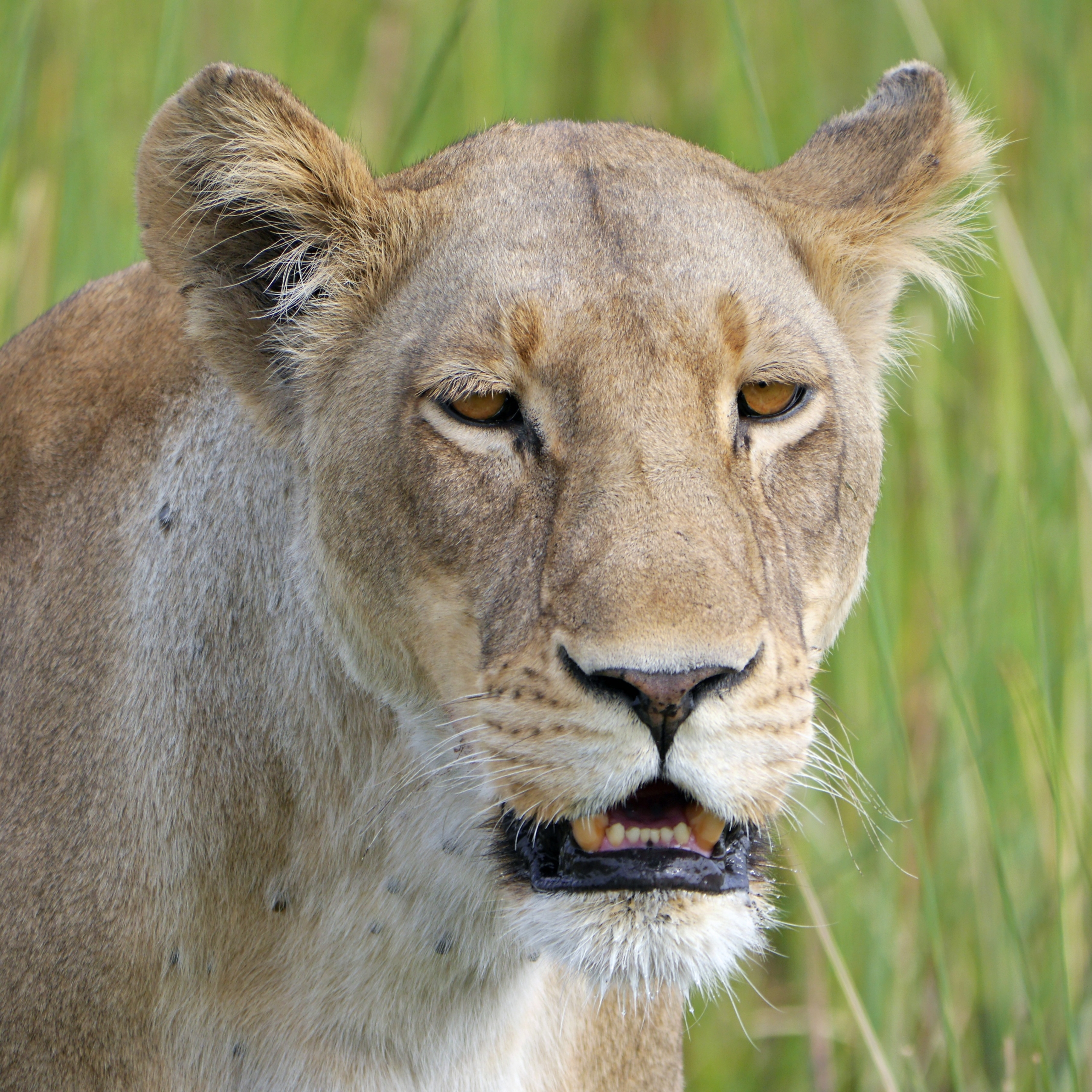
The return of lions to Akagera NP after a period of 15 years is one of Africa’s conservation success stories. In 2015, seven lions (five female and two male) were introduced from South Africa.
Before they became extinct, the park had a population of about 250 to 300 lions. This extinction was because of massive killing by the returning refugees.
With the translocation of lions, their population is steadily increasing and has now grown to over 70 in the park.
African Bush Elephants
The African bush elephant is one of the Big Five animals in Akagera NP. It is the largest and heaviest land animal in the world, weighing about 6000 kg. Mature females give birth every 4–8 years to a single 100–120 kg calf.
African elephants regularly reach the age of 70 years, and their lifespan is strictly limited by their six sets of molars. Once the final set wears down in their 60s, they cannot chew tough vegetation, leading to fatal malnutrition.
About 130 African elephants have been recorded in Akagera NP, and some of these can be spotted around the dense woodland areas, Lake Ihema, and southern lakes.
Cape Buffalo
Cape buffalo are among the Big Five that are worth seeing on Big Five safaris in Akagera National Park. It is one of the large mammals belonging to the Bovidae family and the subfamily Bovinae (cattle, bison, and large antelopes).
This wildlife species is known for its nasty temper and can easily charge at predators, especially when they are in sight.
A mature buffalo weighs between 400 kg and 900 kg; the male and female carry heavy, curved horns.
In 2021, 4,000 cape buffalo were in Akagera NP. This marked a massive recovery from just 500 buffalo in 2010.
Cape buffalo can be spotted in the Kilala Plains and around the shores of Lake Ihema and swamps.
Leopards
Leopards are among the most sought-after Big Five in Akagera NP. They are elusive nocturnal predators with a population of about 15 to 20 individuals.
They live in the southern and western sectors of the park and normally hide in the dense shrubs and wooded valleys and rocky outcrops in the Mutumba Hills.
Since leopards are nocturnal animals, you can easily spot them when on guided nocturnal game drives.
Rhinos
The rhinoceroses are also among the Big Five in Akagera National Park.
In the past years, poaching led to the local extinction of these endangered species, but in 2017 a reintroduction of about 18 rhinos from South Africa was made by African Parks together with the Rwanda Development Board and the Howard G. Buffett Foundation.
In 2019, five more black rhinos were translocated from the Czech Republic to Akagera National Park. Today, the park boasts over 20 rhinos, and a Big Five safari may not be complete without seeing these animals.
White rhinos roam the northern Kilala Plains, while black rhinos inhabit the southwestern hills and can be spotted during day game drives.
The Masai Giraffe
The Masai giraffe, renowned for being the world’s tallest animal, is one of the most amazing animals in Akagera NP. Adult males stand between 3.0 and 4.0 meters (10 to 13 feet) tall, and the females stand between 2.2 and 2.7 meters (7 to 9 feet) tall.
The thriving population of about 135 Masai giraffes can be spotted primarily in the northern and western sectors of Akagera NP.
Zebras
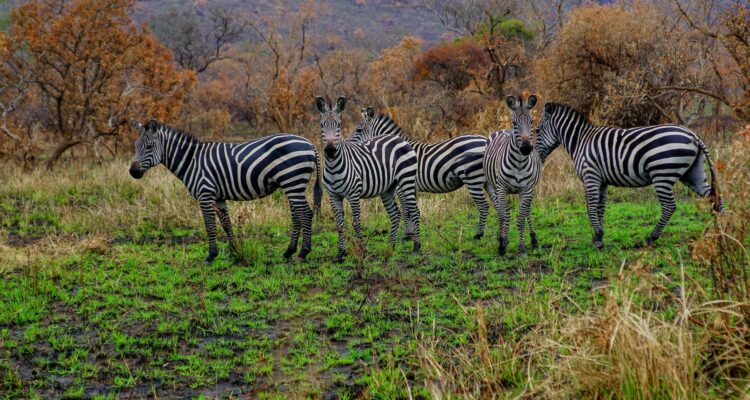
Akagera National Park has a thriving population of over 1,150 plains zebras (Burchell’s zebras), making them one of the most frequently spotted animals on a Rwanda wildlife safari.
Zebras live in strict family units called harems. Big herds are commonly spotted in the northern plains (Kilala Plains), open grasslands, near waterbodies like Lake Birengero and Lake Ihema, and in the southern woodland.
Defassa Waterbuck
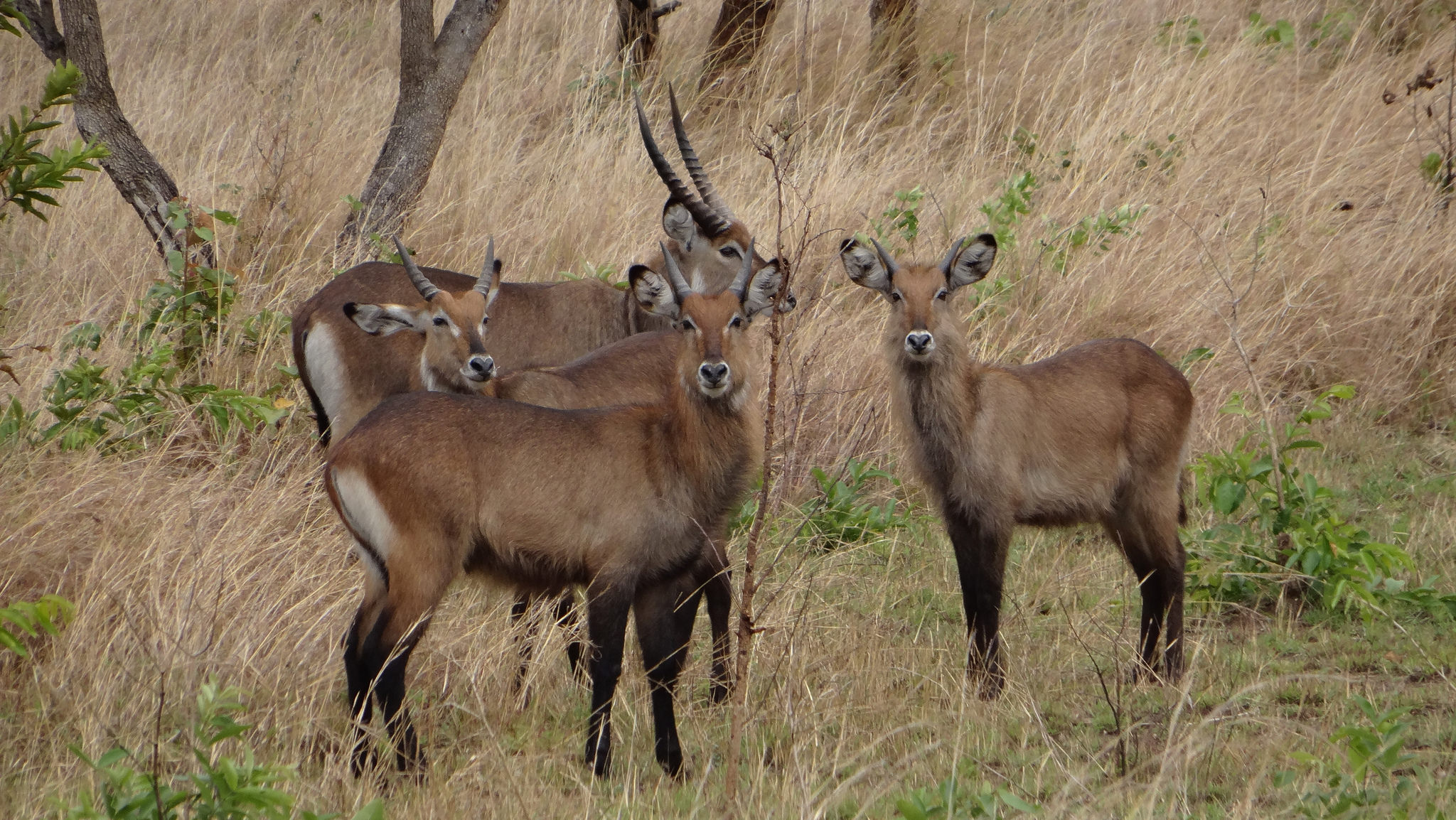
The Defassa waterbuck is one of the most prominent of the park’s 11 antelopes, worth seeing on a wildlife tour in Rwanda.
About 782 Defassa waterbucks live in the Akagera NP, and they can be spotted along the forest-fringed lakeshore and wetlands.
Impalas
Impalas are among the commonly spotted wildlife species in Akagera National Park. These animals constitute a total of about 12,000 individuals, and this makes them the most abundant and frequently sighted antelope species in the park.
Impalas can be spotted in open savannahs, acacia woodlands, and near the lake boundaries.
Giant Crocodiles
The giant crocodiles of Akagera National Park are also called the Nile crocodiles, and they are the largest crocodilian species in Africa and the second-largest reptiles in the world.
These crocodilian species regularly reach an impressive length of 16 to 20 feet, and their population is about 285 mature crocodiles distributed across Akagera’s wetlands. You can spot numerous crocodiles at Lake Rwanyakazinga and Lake Ihema.
Olive Baboons
Olive baboons are the most widespread primates in Akagera NP. These live in troops of between 15 and 50 members, though some families in the park may have more.
These primate species can be seen almost everywhere in the park, but the best spots may include Mutamba Hills and around lakes like Lake Shakani, Lake Muyumbu, and L. Ihema.
Spotted Hyenas
These are the primary nocturnal predator animals in Akagera NP. Spotted hyenas live in complex, female-dominated social clans that rule the park’s savannahs after dark.
The hyenas are known to be highly successful apex hunters, and the best spotting areas are the Mohana and Kilala plains.
Other Animal Species in Akagera National Park
| Topi | Honey badger |
| Cape elands | Sitatungas |
| Cheetahs | Common duiker |
| Banded mongoose | Klipspringer |
| Serval cats | Warthog |
| Side-striped jackals | Bushbuck |
| Genets | Large spotted genet |
| Roan antelopes | Spotted hyena |
| Oribis | |
| Hippopotamuses | |
How to See Various Akagera National Park Animals?
The following are ways to see the wildlife in Akagera National Park.
Guided Day Game Drive
Game drives are the most popular way to experience wildlife in Akagera National Park. These days, game drives are done using 4×4 safari vehicles with a pop-up roof from where you can see the different animals.
Commonly spotted animals on a day game drive include zebras, giraffes, wildebeests, Cape buffaloes, lions, and antelopes, among others.
Guided Night Game Drive
Night game drives offer a unique experience under the darkened sky. On a night drive, expect to see nocturnal animals like leopards, galagos, civets, bat-eared foxes, and genets, among others.
Lucky visitors can also spot the bush babies, one of the rare primates, during these nocturnal game drives.
Park officials from Akagera Management Company run the night game drives.
Guided Nature Walks
Walking safaris allow exploration of the park’s unique landscape. A nature walk is an alternative to traditional game drives and focuses heavily on small-animal encounters and birding.
A Boat Safari on Lake Ihema and Other Water Bodies
Boat trips on lakes like Lake Ihema, a primary hub for boat safaris, will allow you to spot animals in a more relaxed way.
When on a boat cruise on Lake Ihema, you will spot numerous animals like hippos, crocodiles, shoreline herbivores like buffalo and elephants, and sought-after bird species like the rare shoebill stork, the African fish eagle, and other water birds.
Conservation Efforts in Akagera NP
There has been continued species reintroduction, which has been key in restoring ecological integrity in Akagera.
Community involvement in Akagera has also helped to reduce human-wildlife conflict.
The park officials enforce conservation efforts in Akagera, including anti-poaching measures. They use a specialized K9 tracking unit and community programs.
Akagera National Park has implemented scientific monitoring techniques for biodiversity.
Costs Incurred to See Animals in Akagera NP
Akagera NP Entrance Fees
- Foreign non-residents: $100 per adult per day; children (6–12) pay $50; children under 6 are free.
- Foreign Residents: $70 per adult per day; children pay $30.
- Rwandan / EAC Citizens: 15,000 RWF per adult per day; children pay 10,000 RWF.
Activity Costs
- Day/Night Game Drives: $40 per adult for night drives (approx. 2.5 hours).
- Boat Cruises (Lake Ihema): $35 to $45 per adult depending on regular or sunset trips.
- Camping: $25 per person per night.
Guidelines to Follow to See Animals in Akagera NP
- The park is open daily from 6:00 AM to 6:00 PM.
- The speed limit in the park is restricted to only 40 km per hour.
- Stay inside the vehicle except at approved lodge or picnic spots.
- Drive following the designated tracks. Driving off the designated tracks carries a fine of $100.
- Do not use motor horns or loud sounds, as these may disturb the animals.
- Do not feed any wild animals.
- Do not litter in the park.
- Do not take plants, flowers, or rocks.
- Pay attention to the guide’s instructions.
What to Pack for a Wildlife Safari in Akagera National Park?
Some of the key items to pack for a wildlife safari in Akagera National Park include
- Clothing: Long-sleeved shirts and trousers of neutral colour (khaki, beige, and olive green); warm layers for cold mornings and evenings; a rain jacket, and sturdy hiking shoes.
- Gear and other essentials: binoculars, a camera with extra batteries and memory cards, sun protection, insect protection, among others.
- Travel Documents such as a passport, Rwanda tourist visa, and yellow fever card
Accommodation Options in Akagera National Park?
Accommodation ranges from budget to luxury
Budget Accommodation
Dereva Hotel, Muyumba Campsite, Shakani Campsite, Mutumba Campsite, etc. These offer camping activities.
Mid-range Accommodation
Akagera Rhino Lodge and Mantis Akagera Game Lodge, among others.
Luxury Accommodation
Ruzizi Tented Camp and Magashi Tented Camp, among others.
Best Time to Spot Wildlife in Akagera National Park?
The dry season from June to September and mid-December to mid-February is the best time to visit Akagera National Park for wildlife viewing. Easy game viewing during this season is contributed to by thinning vegetation and dry routes in the park
Visits to the park are also possible in the wet season (March, April, May, October, and November). These months are excellent for bird watching and spotting some fauna.
How To Get to Akagera National Park?
Akagera National Park is accessible by road from Kigali, and the drive is about 2.5 to 3 hours.
Head east from Kigali, past Kigali International Airport, then pass through the major hubs of Rwamagana and Kayonza. The travel distance from Kigali to Rwamagana is 50 km, and from Rwamagana to Kayonza is 45 km.
From Kayonza, you will drive about 30 km to the Kiyonza Gate (South Gate), the only authorized entry point to the park.
Tour Operators to Use for Wildlife Tours to See Various Animals
The following are the top tour operators praised for organizing remarkable wildlife safaris in Akagera NP. These also prepare exceptional gorilla tours in Volcanoes National Park.
- Prime Safaris And Tours Ltd
- Wild Gorilla Safaris
- Africa Safaris Tours
- Gorilla Safaris And Tours
- Gorilla Safari Rwanda
Safari Packages in Akagera National Park
Animals in Akagera National Park FAQs (Frequently Asked Questions)
How Many Lions Are in Akagera National Park?
There are about 60 lions living in Akagera NP.
What Are the Big Five Animals in Rwanda?
Rwanda’s Big Five are the leopard, lion, rhino, buffalo, and elephant. These are found only in Akagera National Park.
What Primates Are Found in Akagera National Park?
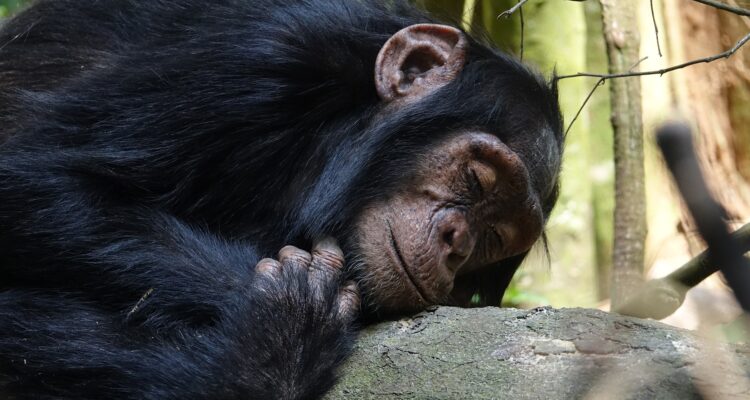
The following are the primates in Akagera NP: baboons, golden monkeys, colobus monkeys, blue monkeys, vervet monkeys, bush babies, etc.
What Wildlife Does Rwanda Have?
Rwanda is home to many different types of wildlife, some of which are:
Wildlife in Rwanda includes primates like mountain gorillas, chimpanzees, golden monkeys, vervet monkeys, bush babies, and other fauna such as warthogs, cheetahs, lions, buffalo, zebras, etc.
Is There Bird Watching in Akagera National Park?
There is interesting bird watching in Akagera NP since the park offers a home to over 500 recorded bird species, including savannah species and water birds, like the rare or elusive highlights like the shoebill stork and papyrus gonolek, among others.
Book your wildlife safari now and discover the incredible animals of Akagera National Park.